
Funded Projects
This page provides key information on EU-funded projects. The aim is to ensure transparency and offer an up-to-date overview of the initiatives.
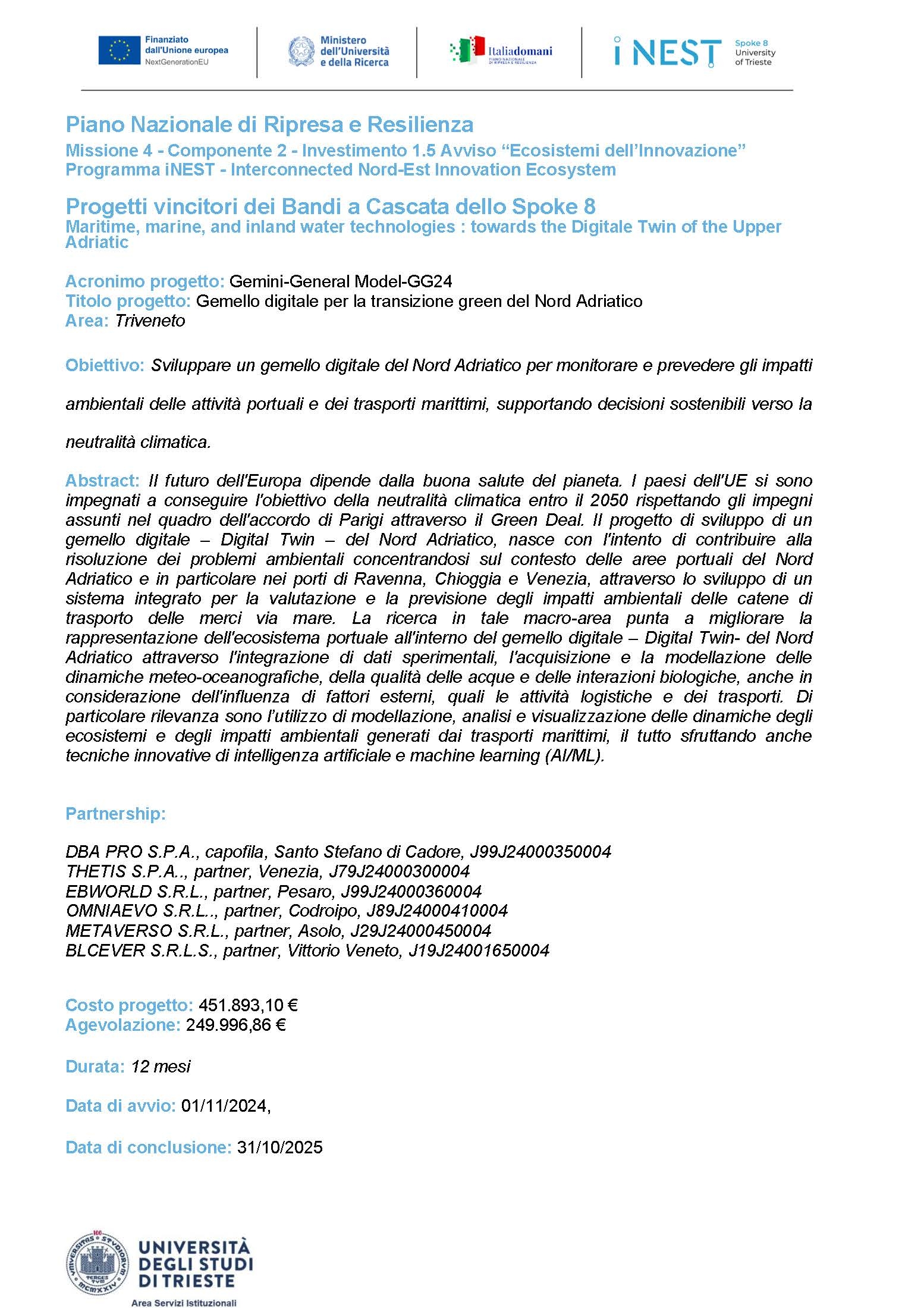
GEMINI - General Model - GG24
Digital Twin for the Green Transition of the Northern Adriatic
The project was born from a very concrete need: to create a digital twin of the Northern Adriatic to improve the understanding and control of greenhouse gas emissions in maritime transport. We focused on the ports of Ravenna, Chioggia and Venice, developing a tool capable of measuring the port carbon footprint through environmental sensors, ship data and information from logistics processes.
At the core of our approach is the so-called “Twin Transition,” a concept promoted by the European Commission that integrates digital innovation and environmental sustainability. It is not about choosing between digital and green, but about using them as joint levers. Today’s world must face two challenges: adopting advanced technologies for economic competitiveness and mitigating climate change through sustainable practices. GEMINI demonstrates that these objectives are not in conflict, but rather reinforce each other.
GEMINI is based on four main pillars, integrated technologies that communicate with each other in terms of information and processes: GIS (Geographic Information System) for the geolocated representation of the context, BIM (Building Information Modeling) for infrastructure management and maintenance, the DIH (Digital Information Hub) an integrated IoT environment that collects information and data and Big Models (trained models) adapted to the specific context to support stakeholders in evolutionary and decision-making processes.
It offers several key features:
- Real-time monitoring: the platform continuously monitors water and air quality in the port area, providing updated and reliable data.
- Dashboards and cross-analysis: through intuitive visualizations, it enables integrated data analysis, identifying meaningful correlations and patterns.
- Global CO₂ emissions calculation: one of the most innovative aspects is the ability to accurately calculate carbon dioxide emissions across the entire port ecosystem.
- Predictive models: thanks to artificial intelligence and machine learning, the system can forecast future scenarios, enabling proactive rather than reactive interventions.
- 3D viewer: finally, a three-dimensional representation of the port area facilitates spatial understanding of phenomena and makes the system accessible even to non-technical users.
GEMINI demonstrates how digital technology can be a powerful tool for environmental sustainability. Through the integration of IoT, artificial intelligence, and machine learning, we have created a platform that not only monitors but also predicts and supports informed decision-making for more sustainable management of port activities. The digital twin is not just a virtual replica: it is a tool that promotes collaboration among different sector stakeholders, facilitating information sharing and cooperation toward common sustainability goals.
The GEMINI - General Model - GG24 project (CUP: J99J24000350004) is funded within the research program of the innovation ecosystem “iNEST – Interconnected Nord-Est Innovation Ecosystem,” Spoke 8 entitled “Maritime, Marine, and Inland Water Technologies: Towards the Digital Twin of the Upper Adriatic” (CUP UNITS J43C22000320006), under the resources of the PNRR, M4C2 – Funded by the European Union, NextGenerationEU – Project ID 32DED09C9C.
 |
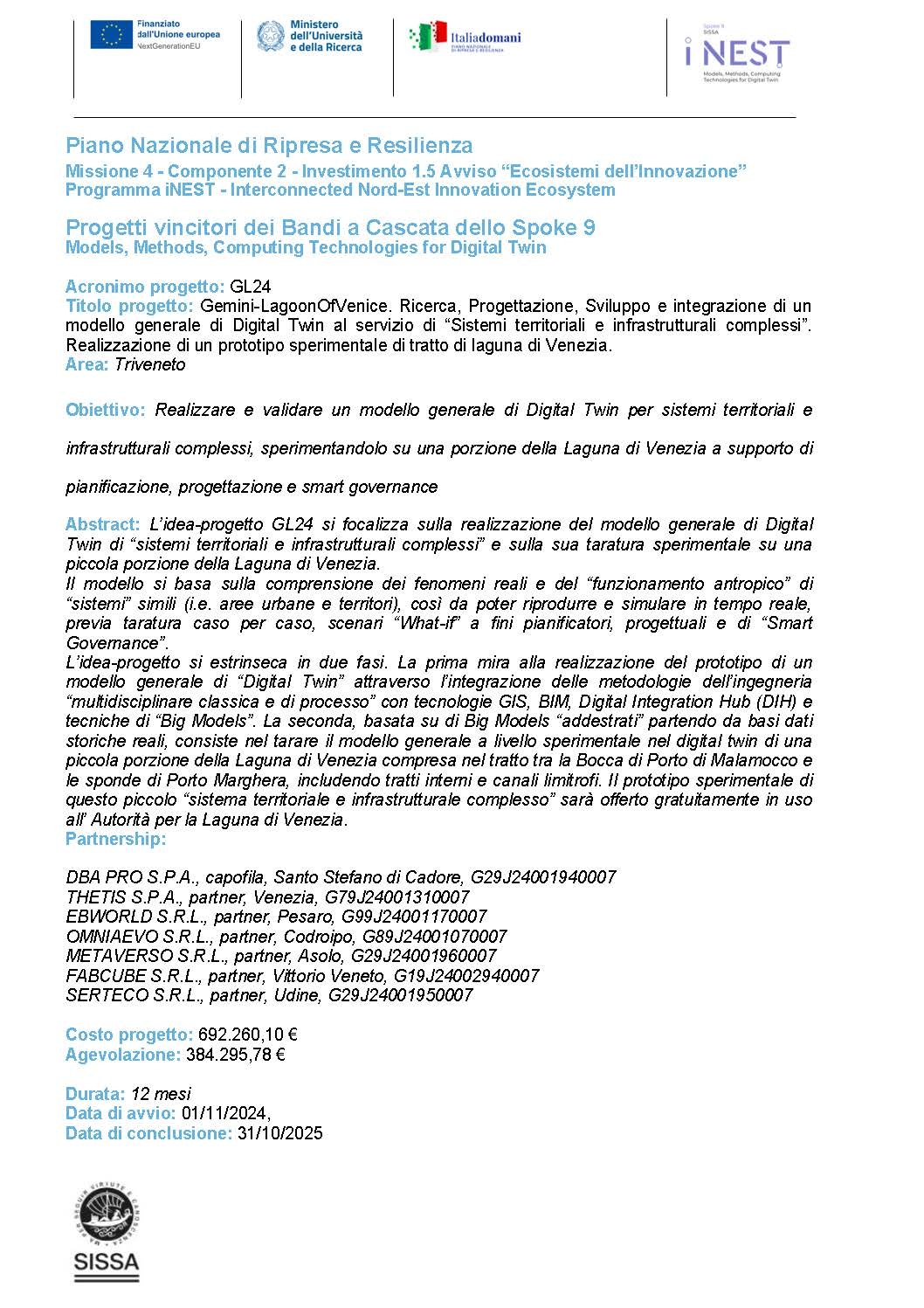
GEMINI - Lagoon of Venice - GL24
Research, Design, Development and Integration of a General Digital Twin Model for “Complex Territorial and Infrastructural Systems”. Creation of an Experimental Prototype for a Section of the Venice Lagoon
The project idea “GEMINI - Lagoon of Venice - GL24” focuses on developing a general model for integrated systems, designed to support the understanding of real-world phenomena and to reproduce and simulate, following case-by-case calibration, “what-if” scenarios for planning, design and Smart Governance purposes.
As a systemic digital replica, GEMINI aims to support its users in managing “complex territorial and infrastructural systems,” guiding and assisting them in making informed and effective decisions.
What makes the project particularly innovative is its holistic approach. GEMINI is not simply a monitoring and control platform, but an integrated ecosystem that can be imagined as a tetrahedron, at the center lies the system itself, while at its four vertices are key components working in synergy:
- A Geographic Information System (GIS), for organizing spatial and territorial data
- A Building Information System (BIM), for managing parametric three-dimensional models
- A Digital Information Hub (DIH), a platform that integrates data from heterogeneous sources
- A Big Model assisted by Artificial Intelligence, capable of simulating complex behaviors and dynamically adapting
This four-part architecture enables an integrated and multi-dimensional view of the lagoon ecosystem.
One particularly noteworthy aspect is how the project fully embodies the concept of “Twin Transition” - the convergence of digital twin innovation and sustainability. It is not about choosing between technological innovation and environmental sustainability, but about enabling them to work together. GEMINI uses IoT, artificial intelligence and machine learning not as ends in themselves, but as tools to achieve more sustainable ecosystem management. It is a concrete example of how digitalization can serve both the environment and local communities.
The creation of the Digital Information Hub has been especially significant. In a complex environment such as the lagoon, where data come from highly diverse sources, including Consorzio Venezia Nuova monitoring stations, Copernicus Marine services, OpenWeather data, and AIS vessel tracking systems, it was essential to establish a “single source of truth.” The DIH is not merely a repository but a dynamic ecosystem that harmonizes diverse datasets, overcoming the fragmentation of existing monitoring systems.
From a technical perspective, the tidal forecasting system deserves special mention. By applying model order reduction techniques such as Dynamic Mode Decomposition and Proper Orthogonal Decomposition, we developed a predictive model capable of delivering accurate results in significantly shorter times compared to traditional high-resolution models. This enables timely decision-making when it matters most.
Real-time monitoring of water and air quality, dashboards with cross-analyses, predictive models, and a 3D viewer complete a technological framework that is both extensive and, above all, functional.
The selected pilot area - the stretch between the Malamocco inlet and Porto Marghera, known as the Canale dei Petroli - represents a microcosm of the challenges faced across the entire Lagoon. Offering this prototype free of charge to the Venice Lagoon Authority is not only a generous gesture but also a demonstration of confidence in its practical usefulness.
Perhaps the most promising aspect is that GEMINI has been designed as a generic, scalable, and customizable model. Once validated in the Venice Lagoon, this approach could be replicated across other fragile ecosystems, complex infrastructures, territories that require integrated and data-driven management.
The project “GEMINI - Lagoon of Venice: Research, Design, Development, and Integration of a General Digital Twin Model for ‘Complex Territorial and Infrastructural Systems.’ Creation of an Experimental Prototype for a Section of the Venice Lagoon” – acronym GL24 (CUP: G29J24001940007) – is funded within the research program of the innovation ecosystem “iNEST – Interconnected Nord-Est Innovation Ecosystem,” Spoke 9 entitled “Models, Methods, Computing Technologies for Digital Twin” (CUP UNITS G93C22000610007), under the resources of the PNRR, M4C2 – Funded by the European Union, NextGenerationEU – Project ID 32DED192AB.
 |